
A new survey shows it's the younger generation that lies awake at night worrying about AI taking their jobs, while their older colleagues are far less concerned.
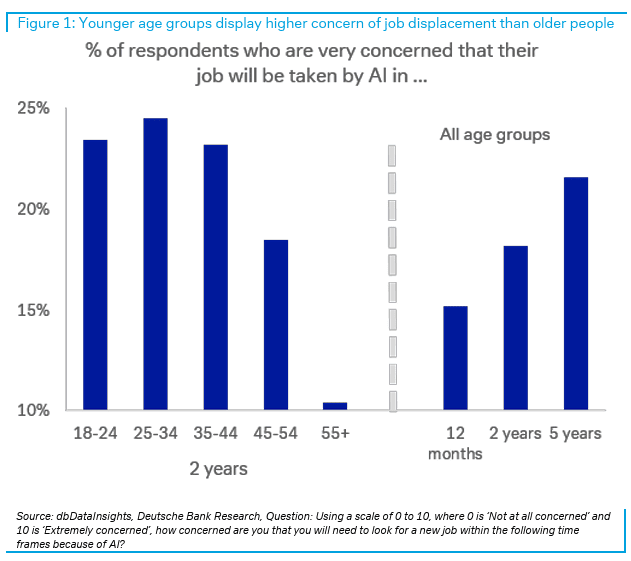
According to exclusive research by Deutsche Bank, nearly one in four workers aged 18–34 gave a score of 8 or higher out of 10 when asked how worried they were about losing their job to AI in the next two years.
Among those 55 and older, that number dropped to just one in ten.
It's not hard to see why:
Younger workers are more likely to be in roles directly exposed to automation and AI tools. Unemployment has already been ticking higher for younger age groups in the U.S. and Europe, and the fear is that AI could make that worse.
The survey data echo a recent study from Stanford University that shows employment for young graduates aged 22-25 has declined by 6% in AI-exposed occupations such as software engineer and customer service compared to its peak in late 2022.
Another study of U.S. CV and job posting data by Harvard University this month found a sharp decline in junior employment in firms adopting AI while senior employment rose.
The survey covered 10,000 people across the U.S. and major European economies between June and August.
It revealed not just a generational split, but also a geographical one. Americans were consistently about five percentage points more concerned than their European peers, suggesting they see AI adoption accelerating faster on their side of the Atlantic.
Looking further ahead, anxiety only grows: While 18% of all respondents are highly concerned about the risk of AI within the next two years, that figure rises to 22% when the time horizon stretches to five years.
Workers seem to sense that AI’s impact is not immediate and sudden, but gradual and compounding.
Interestingly, the survey also found strong demand for AI training and evidence that many workers are already educating themselves. That points to a workforce that may be fearful, but also pragmatic - looking to adapt rather than simply resist.
The story here is not that everyone fears AI equally. It's the young who see the risk most clearly, perhaps because they feel they have the most to lose.
For older workers, closer to retirement and less exposed to entry-level automation, the concern is far more muted.